 | |
| Badmington Horse Trials c1971 © Richard
Coomber |
Walk report:: 18th August 2022 Matley Wood with Jo Dowle
Lym Nats met in the Matley Wood car park on a sunny morning just a few days after the drought had broken. There were immediate signs of the effect of the recent downpours, with patterned tracks in the woodland debris as the rainwater had run down the paths.
We made our way through part of the campsite and down the path heading north through this old woodland, hearing various common birds: Robin, Chaffinch, Great Tit. A Redstart and a Raven were heard by some. A large oak near the path had an active wasp nest in a cavity, happily at high level, so we could safely view their activity and the beautifully patterned nest.

Wasp nest © Chris Robinson
The wood contains a good variety of deciduous trees, although the oldest (according to the woodland trust veteran tree map) are off the paths, hidden in the Bracken. There was a notable large Common Lime tree along with the usual oak, Beech, Sweet Chestnut, Holly and Ash. Several fine specimens of the bright orange Chicken-of-the-Woods fungus were seen, some of which had grown in just over a week (since the walk recce).
 |
| Chicken-of-the-Woods © Richard Smith |
Once we emerged from the wood onto Matley Heath we headed northeast, passing two raised areas covered in Bracken which are Bronze Age burial mounds. A Buzzard could be heard calling and we eventually spotted two perched not far off in the trees. A deeply cut path then leads down to a small stream, a tributary of the Beaulieu River. There were many nest holes of solitary bees and wasps in the sandy sides of the path, but only a few small unidentified bees seen. The banks had examples of all 3 heather species as well as Dwarf Gorse.

Common Carder Bee on Dwarf Gorse © Richard Smith
We stopped for a rest underneath a larger mound where a very young calf could be seen hiding in the bracken. This circular bank and ditch have been been identified as Neolithic and apparently the oldest settlement in the New Forest. An interesting short video account of the dig there in 2019 is at https://www.facebook.com/watch/?v=2490654740998924
After our rest stop, where a few birds were seen (Great Spotted Woodpecker, Meadow Pipit and Goldfinch but sadly not the family of Woodlarks seen here on the recce visit) we followed the stream west along the river to a bridge where we headed south back towards Matley wood. Devil’s-bit Scabious and Creeping Willow were amongst the plants noticed. Many grasshoppers and spiders were seen living in the heather. A few butterflies were around, notably a Grayling with its fantastic camouflaged underwings. In the tall Gorse area near the wood’s edge there were Stonechats and we saw a small carved wooden figure of a Madonna which has apparently been fixed to an oak tree for more than 20 years (according to a regular visitor to the campsite).
 |
| Mottled Grasshopper (Myrmeleotettix maculatus) © Chris Robinson |

Grayling © Chris Robinson
As we made our way back up the hill to the
campsite and the car park, a lucky few at the front of the group had a very
close encounter with an Adder which was lying right on the path. I estimated it
to be 50cm or more, with very striking dark zig-zag markings. It only stayed in
view long enough for this photo of its rear half! JD
 |
| Adder © Chris Robinson |

Our route
© Crown copyright 2022 Ordnance Survey. Media 005/22.
The licence is valid until 31 December 2022
Walk report: Oakley and Mill Lawn with Pam Poole
On a warm sunny morning our group set out to walk a circular route from the Oakley car park down to Mill Lawn and to return through Burley New Inclosue to Lucy Hill. After crossing the road we came to a lawned area which is usually boggy but after all the hot weather it was completely dry with just one small area of Marsh Pennywort and Marsh St John's-wort. From here we entered a small deciduous wood which skirts the main inclosure. There were several fallen oak and two Speckled Wood butterflies swirling together in a boundary dispute.
 |
| Marsh Pennywort © Richard Coomber |
Leaving the wood the area opens out to lawn and gorse.
Gatekeeper butterflies were fluttering around and well camouflaged on the brown
grass. Continuing on we came to an area of grassy mounds. These mounds can be
found around the forest lawns where flooding occurs. It is now thought that
they have been formed where purple moor grass has been heavily grazed by the
ponies. When an area floods, and the water retreats, silt is deposited around
the tussocks of grass. Eventually over many years a mound is formed. Each mound
appeared to have its own little ecosystem of plants and insects. Here we had
good sightings of a male Redstart together with flocks of Linnets and
Goldfinches, and also found 2 Robin’s Pincushion on dog rose, these are caused
by the larvae a gall wasp called Diplolepis rosae, they were bright
green at the moment, eventually they should turn red.
 |
| Redstart - male © Richard Smith |
On reaching Mill Lawn Brook we turned left to follow the
meanderings of the stream. Growing on the stream’s banks were Marsh Thistle,
Water Mint, Lesser Spearwort, Marsh Ragwort and Chamomile, and also Skullcap
which was very pleasing. In the stream itself there was Fringed Water-lily but
only a couple of yellow flowers showing. On the lawn there was Silverweed,
Yarrow, Tormentil and just one solitary plant of Sneezewort. Patrolling the
water was an Emperor Dragonfly one Beautiful Demoiselle was spotted and a White-legged Damselfly was photographed.
Birds seen in this area were, a very pale Buzzard, Nuthatch, Carrion Crow, Song
Thrush, Meadow Pipit, Swallow and 3 Grey Heron flying low and calling to each
other. A flock of Starlings was present and a Green Woodpecker was heard.
 |
| Skullcap © Sue Skarstein |
 |
| Unbranched Bur-reed © Sue Skarstein |
 |
| White-legged Damselfly © Richard Smith |
On leaving the stream we walked towards Burley New
Inclosure, again passing through another area of grassy mounds. We took time to
look at the intricate webs of Funnel Spiders, the spiders sitting centrally in
their funnel behind large sheets of webbing. As we approached the woods all
three species of heather were seen, Ling, Cross-leaved Heath and Bell Heather.
 |
| Lesser Skullcap © Richard Smith |
Finally as we reached Oakley car park, in the shade was
one small patch of Bog Pimpernel, in an area which is usually boggy but at the
moment has dried out. PP
 | |
Our route
|
Walk report: 21 July 2022 Culverley with Robert and Glynis Payne
 |
| Horsefly habitat © Richard Smith |
We convened in Culverley car park, near Beaulieu, on a cooler day compared to recent extremes.
Setting off down a bank we paused a while on a little bridge over a quiet stream, admiring the flashes of fluttering colour from the Holly Blue, Gatekeeper and Beautiful Demoiselle damselflies.
 |
| Holly Blue © Sue Skarstein |
 |
| Blackcap - immature © Chris Robinson |
Passing through open areas we saw Mistle Thrush and, circumventing cattle sheltering in an oasis of shade, made our way into Tantany Wood, finding Redstart, Long-tailed Tit, Nuthatch, Treecreeper, Wren and several sightings again of Spotted Flycatchers.
 |
| Woodland Grasshopper © Andy Skarstein |
 |
| Silver-studded Blue - female © Chris Robinson |
We found Dwarf Gorse and Coral Necklace and Round-leaved Sundew where once it would have been wetter, a couple of Common and Silver-studded Blue butterflies and a Dark Giant Horsefly.
 |
| Dwarf Gorse with Ling © Chris Robinson |
 |
| Coral Necklace © Richard Smith |
 |
| Dark Giant Horsefly © Andy Skarstein |
 | |
Our route
|
75th Anniversary tea party 23 June 2022
With the relaxation of Covid rules we were a year late celebrating the 75th Anniversary of the founding of Lymington & District Naturalists' Society with an afternoon tea at South Lawn Hotel, Milford-on-Sea.
After a welcome introduction from Robert Payne, our Chairman, we were treated to a superb digital photographic presentation by Steve Laycock, which in turn was followed by an excellent tea!
 |
| Robert welcomes members and guests © Tina Vaughan |
 |
| and Steve begins his presentation © Tina Vaughan |
 |
| Somewhat better than the biscuits on our Thursday morning walks © Tina Vaughan |
Afterwards a group photograph taking by Steve and subsequently published in the Lymington Times.
 |
| and finally, the group photo © Steve Laycock |
Thanks to Glynis Payne and Sue Skarstein for their organisation, to Steve for his presentation and to South Lawn for an excellent tea. Over the last 75 years our members have made LymNats a special society and without them this celebration would never have occurred!
Walk report: 07 July 2022 Isle of Wight led by Richard Smith
On a cool, overcast morning, ten of us gathered for the morning sailing from Lymington to Yarmouth. As we departed, we spotted large numbers of Canada Geese on the Lymington marshes, with a single Barnacle Goose amongst them. Shelduck, and most gull species were seen at the low tide mark along with Common and Little Tern flying past as we crossed the Solent.
 |
| Cinnabar caterpillars on Common Ragwort © Chris Robinson |
Near
Yarmouth, we watched a pair of Rooks digging for grubs on the verge by the
terminal. As we approached the railway track the botanists amongst us
identified Bristly Ox-tongue, Common Orache, Prickly Lettuce, Marsh and Common
Mallow, Fennel, Common Sea-lavender as well as Creeping, Marsh and Spear
Thistles. Cinnabar moth caterpillars were feeding on a Common Ragwort plant, but
not on the any others we passed on the walk. We paused to look over the reed
bed next to Mill Copse and heard a Reed Warbler as a Swift flew overhead.
Alongside the railway track Brambles were in flower but only a few Gatekeeper
were about in the cooler part of the day.
 |
| Mating Gatekeepers © Chris Robinson |
 |
| Greylag Goose © Chris Robinson |
 |
| Redshank and Curlew © Richard Smith |
We elected for an early lunch stop at the End of the Line Cafe, sat outside in the sun, and as the day warmed, saw more butterfly amongst the grasses and wild flowers around the perimeter; Meadow Brown, Marbled White, and Small Skipper all appeared.
 |
| Small Skipper © Chris Robinson |


After
lunch, a brief foray around the Afton Marsh Reserve gave views of a Jay, and
Moorhen and Mallard ducklings paddled in the stream running around the reserve.
 |
| Jay © Chris Robinson |
Returning
through the churchyard at Freshwater and across the fields beyond Kings Manor
Farm, the sun came out and as the day got even hotter, large numbers of
butterfly were seen with Gatekeeper, Painted Lady, Common Blue and Peacock all
added to our list. Passing through Saltern Wood, an active and noisy colony of
wild Honey Bees were seen in a tree close beside the path and observed from a
respectful distance.
 |
| Wild Honey Bees © Chris Robinson |
A brisk
final walk across the swing bridge allowed us to catch the planned afternoon
sailing and it was good to end a warm day sitting in the sea breeze to cool off
as we sailed back home after a total walk distance of about 5.5 miles. RS
 | |
Our route
|
Walk report: 09 June 2022 Sturt Pond and Hurst Spit with Julia Race and Andrea Janssens
We set off from the Sea Road Car Park in Milford-on-Sea at low tide; aware parts of the route to Sturt Pond are flooded at high tide. Passing through the metal gate in the far corner of the car park we saw one of the wall rocket species and Dove’s-foot Cranesbill in bloom.
The path took us past banks of Brambles, Common Stinging Nettles
and large stands of Hemlock Water Dropwort. By the first wooden bridge we heard
a Cetti’s Warbler.
Moving on past thick hedgerow we saw Common Mallow, Hogweed,
Salsify (spectacular seed heads and mauve flowers), white Foxgloves, Spear Thistle,
Bittersweet (Woody Nightshade), white flowered Common Comfrey and a young Robin
in a birch tree.
 |
| Salsify with Swollen-thighed Beetle © Chris Robinson |
 |
| Syrphus vitripennis - a hoverfly © Chris Robinson |
After a section on pavement, the path headed towards the
reed beds. Hedge Woundwort with dark pink flowers, Honeysuckle, a fumitory, and
White Campion filled the hedgerow and a Reed Bunting was heard.
Just past a small bridge the view opened up and we studied a beautiful metallic-green Swollen-thighed Flower Beetle on patch of Ox-eye Daisies in the sun. Other plants identified here included Pink Oxalis (garden escapee), Smooth Sow-thistle, Common Mallow, Purple Toadflax and Scots Pine with numerous cones.
 |
| Swollen-thighed Beetle on Ox-eye Daisy © Glynis Payne |
 |
| Bittersweet © Richard Smith |
As we approached Sturt Pond we saw Yellow Iris, Silverweed
and Charlock in flower. A vole scurried
across the path.
 |
| Sturt Pond from Hurst Spit © Glynis Payne |
Along the edge of Sturt Pond we saw these plants: English Scurvygrass,
Sea Beet, Sea Mayweed, Sea Milkwort, Sea Aster, Lesser Sea-spurrey and Sea Purslane
and a variety of birds: Shelduck, Herring Gull, Black-headed Gull, two
Cormorants in flight, Gadwall, Little Egret, and Oystercatcher. On reaching the
Hurst Spit end we saw Thrift, Field Bindweed (small pink flowers), Sea
Plantain, Buck’s-horn Plantain and Common Bird’s-foot-trefoil.
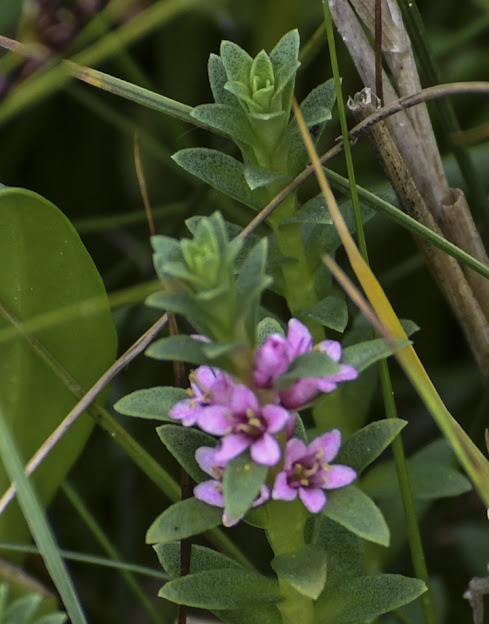 |
Sea Milkwort © Chris Robinson |
 |
| Lesser Sea Spurrey © Julia Race |
To finish the walk we retraced our steps alongside Sturt Pond and back to the car park.
 | |
Our route
|
Subscribe to:
Posts (Atom)