'Walk' report: 18 July 2019: Mothing at North Weirs, Brockenhurst


Our moth event in Angela’s garden was well attended, but was rather more sedentary than the usual Thursday walk. A bin-type Robinson trap was left running overnight. With a 125w bulb it lured a good variety of moths into the trap, but unlike last year there were no Hornets. We sat around the tables in the shade where Richard and Mary talked their way through the moths that had settled on the egg trays that had lined the inside of the Robinson trap. Some 47 species were noted, and one or two others might have been missed off the notebooks! Last year we recorded 49 – so not so different in totals, but this year we noted over 30 species not previous recorded at the site.

Not all were little brown jobs as some of their names indicated - Mother of Pearl, Ruby Tiger, Rosy Footman, Purple Clay and Flame Shoulder. Others with names like Dark-barred Twin-spot Carpet and Bright-line Brown-eye helped to identify the species. Some were large and quite spectacular such as Swallow-tailed Moth and three hawkmoths – Elephant, Poplar and Pine. Those classed as micro-moths were mostly tiny, but in some cases, such as Oak Longhorn, certainly not little brown jobs.

Once the trap had been emptied a number of obliging moths were encouraged to pose on logs for those with cameras and these included some species that had been caught at either Milford or Pennington overnight. With the end of the event the moths were returned to their respective home areas.

Richard would like to thank Mary for her assistance in the morning. Angela and Robert for hosting the event and of course all the members whose enthusiasm helped make it a most interesting and enjoyable morning. (RC)

Micro Moths
Scientific name
English name
Agapeta zoegana

Anania coronata

Ancylis badiana

Brachmia blandella

Carcina quercana
Oak Longhorn
Chrysoteuchia culmella
Garden Grass-veneer
Ditula angustiorana
Red-barred Tortrix
Endotricha flammealis

Hofmannophila pseudospretella
Brown House-moth
Pandemis heparana
Dark Fruit-tree Tortrix
Pleuroptya ruralis
Mother of Pearl
Plutella xylostella
Diamond-back Moth
Pyrausta purpuralis

Tachystola acroxantha

Teleiodes vulgella

Udea ferrugalis
Rusty-dot Pearl
Ypsolopha dentella
Honeysuckle Moth

 
Oak Longhorn - a micro

Macro moths
Scientific name
English name
Agrotis exclamationis
Heart and Dart
Apamea monoglypha
Dark Arches
Cosmia trapezina
Dun-bar
Crocallis elinguaria
Scalloped Oak
Cyclophora albipunctata
Birch Mocha
Deilephila elpenor
Elephant Hawk-moth
Diarsia brunnea
Purple Clay
Eilema depressa
Buff Footman
Eilema lurideola
Common Footman
Hoplodrina blanda
Rustic
Hoplodrina octogenaria
Uncertain
Idaea biselata
Small Fan-footed Wave
Idaea dimidiata
Single-dotted Wave
Laothoe populi
Poplar Hawk-moth
Lomaspilis marginata
Clouded Border
Lycophotia porphyrea
True Lover's Knot
Meganola albula
Kent Black Arches
Mesapamea secalis agg.
Common Rustic agg.
Miltochrista miniata
Rosy Footman
Mythimna albipuncta
White-point
Mythimna ferrago
Clay
Mythimna impura
Smoky Wainscot
Mythimna pallens
Common Wainscot
Ochropleura plecta
Flame Shoulder
Ourapteryx sambucaria
Swallow-tailed Moth
Parascotia fuliginaria
Waved Black
Phalera bucephala
Buff-tip
Scopula imitaria
Small Blood-vein
Sphinx pinastri
Pine Hawk-moth

 
Blood-vein

Swallow-tailed Moth


 Photographs © Richard Coomber


Walk report: 04 July 2019 Canadian Memorial and Mockshade

Small Copper
© Chris Robinson

On a bright, sunny morning, 16 of us set off from the Canadian Memorial car park. We entered the woods by the gate and walked along the gravel cycle path until it veered off to the left. We kept straight on to a green path and were immediately surrounded by butterflies. A Small Copper caught our eye, as did a skipper (Essex or Small, it was too quick for us to tell). There were Meadow Browns everywhere and both Common and Silver-studded Blues were abundant. Silver-washed Fritillary, Red Admiral and Large White were present. A Golden-ringed Dragonfly patrolled up and down the ride, and several moths and grasshoppers were seen.

In the trees we spotted a Tree Pipit and a Goldcrest, Robins were about and a Green Woodpecker was heard. We followed the path downhill to the foot-bridge over Long Brook. Here we saw Grey Wagtails and another Silver-washed. 
Tree Pipit
© Chris Robinson

The Environment Agency was doing a survey of the stream and we eat our biscuits whilst talking to them. They had caught (via an electrofisher) Brown Trout, Bullhead (also known as Miller’s Thumb), Minnows and a Brook Lamprey.

Four-spotted Chaser
© Chris Robinson
Large Skipper
© Glynis Payne
Common Blue - male
© Glynis Payne
We then walked up the hill, again there was an abundance of Meadow Brown and various blue butterflies. We saw Stonechat and Meadow Pipit and heard a Blackcap. When we reached the top of Mockshade Hill the views were stunning. We turned left, back into the shade of the trees and down to the pond. There were too many dragonflies and damselflies to count. I reckon there were at least six different species, if not more. These included Broad-bodied Chaser, Four-spotted Chaser, Common Darter, Small Red Damselfly and Common Blue Damselfly. 

We continued down the path and were surprised to see movement ahead. There is a large puddle where water from the last rains persists. The local birds were taking advantage of this. Nuthatch, various tits, goldfinch and a family of Long-tailed Tits were all bathing and drinking. We stood transfixed until I made the executive decision to move on. Only then did we see the Grass Snake slither through the water and out on to the verge. Along the edges of the path Grey Agarics were growing.

When we got back to the cars most people headed off for home, but 7 of us crossed the road to visit the holly grove across the way. We had very good views of Great-spotted Woodpecker, Chaffinch, Blackbird, Great Tit and Robin. Goldcrest was heard and, as we were walking back up the cycle track, we caught a fleeting glimpse of a Redstart. CNR

Environment Agency Surveying
© Glynis Payne
Brook Lamprey
© Glynis Payne 


Walk report: 20 June 2019 Norleywood


Heath Spotted Orchid
© Chris Robinson

On a mild cloudy morning 26 of us entered Norley Inclosure. This very pleasant wood has undergone some selective conifer thinning recently, with many wood stacks consisting mainly of Douglas Fir. As the sun came out Speckled Wood butterflies were fluttering together protecting their  territories and a female Beautiful Demoiselle was seen. Along the
track verges Enchanter’s nightshade, Nipplewort and Foxgloves were growing.


Grey-spotted Amanita
© Duncan Wright
We turned left at the pound. This area is always wet, and was very muddy due to the recent rain. Here our group split into those prepared to skirt the pound and risk the mud, and those prepared to try and get through the pound, both of which caused some merriment. The path which goes along an old drove is slightly raised at this point with wet areas either side. Here  species seen were Marsh Penny-wort, Lesser Spearwort, Pale Persicaria, Marsh Cud-weed, Toad Rush and Marsh St John’s-wort, also a Common Frog, Hornet and Red Admiral were spotted. Walking on a puzzling bird call was heard, and then unexpectedly a Helmeted Guineafowl was found.  As the path opened out to the heath, Wood Ants from a nearby nest were trying to move what looked like a dead young Slow Worm. Several times we came across the fungi Grey-spotted Amanita.


Meadow Thistle
© Chris Robinson
From the heath we walked down to Crockford stream. Flowers seen were Heath Bedstraw, Tormentil, Heath Speedwell, Saw-wort, Meadow Thistle, Yellow Pimpernel, Bell Heather, Spotted Heath Orchid and Lesser Water Plantain was found in a damp shaded area, also Common Cow-wheat bordering the wood. At the stream we stopped for biscuits and had a chance to identify more flowers. There were both Water and Creeping Forget-me-nots, Marsh and Meadow Thistles, Water-cress, Water Crowfoot sp,  Burnet Rose and Bog-myrtle.


Lacewing on Gorse
© Glynis Payne
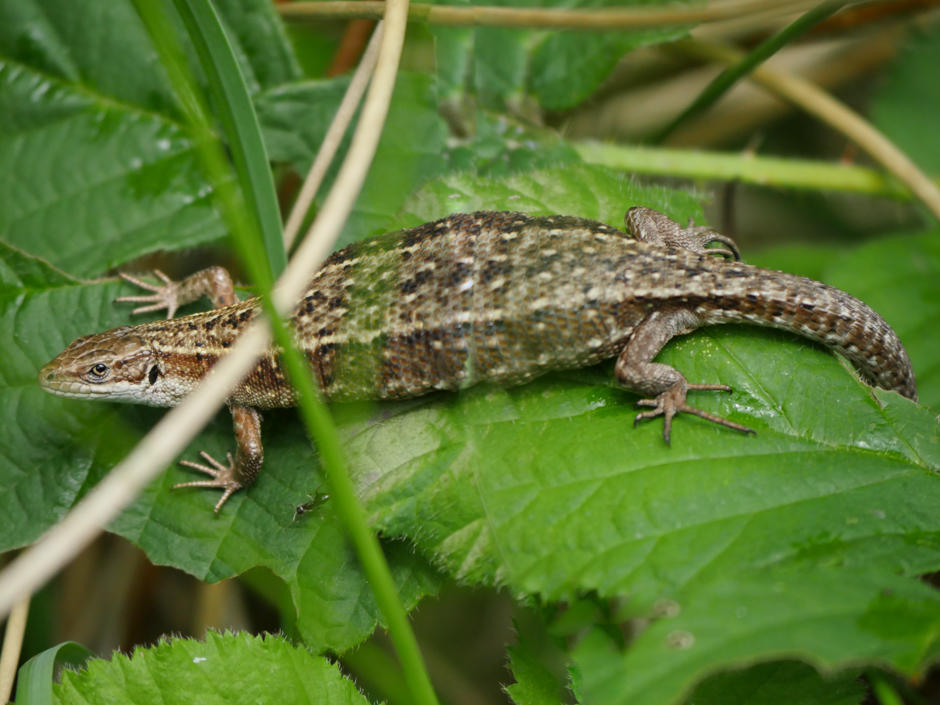
Then retracing our steps  we turned right following the edge of the wood overlooking Lower Crockford Bottom and eventually re-entered Norley Inclosure. Here a Green Lacewing was seen and photographed. The different species of some of the Green Lacewings can be difficult to identify, and even from the photograph species identification was not possible. Some members at the rear of our group were lucky enough to see a Common Lizard before returning to the car park.


Not many birds were spotted on this walk, Blackbird, Chaffinch, Robin, Woodpigeon, Goldfinch and Green Woodpecker were seen and Chiffchaff, Blackcap, Jay, Coal Tit, Wren, Nuthatch, Siskin, Song Thrush, and Willow Warbler were heard. Other plants seen were Round-leaved Sundew, Oblong-leaved Sundew, Bog Asphodel, Cross-leaved Heath, Sheep’s Sorrel, Lousewort, a Bog Stitchwort and Hard Fern. The only other fungi was Chanterelle. PP
Common Lizard
© Richard Smith